Sunday, May 5, 2013

Concluding Post: An Open Letter to My Students


Concluding Post: An Open Letter to My Students


Dear past, current and future students:

Through writing you this letter I have been able to reflect on my own teaching and learning experiences and define my own life’s (as a teacher) personal curriculum. As I strive to define my own beliefs about teaching and curriculum I hope to shed some light on current classroom practices and offer you an understanding of why I hold specific beliefs so high.

During the elementary years I attended a small catholic elementary school roughly 2 miles from my house. My father, his brothers and sisters and their children all attended this same elementary school. My class sizes ranged from 18-24 and there was only one teacher per grade level.  I had varied experiences during elementary school. Many of my teachers were very strict and we spent most of the day in our seats writing with a pencil and paper. A practice that I that try to do as little as possible!

In 6th grade I transferred to the local Public School where I eventually graduated Salutatorian of my class. It was during my Junior and Senior year that I really developed an interest in teaching. Each day for an hour I went to a specific 5th grade classroom. The teacher, also my volleyball coach, allowed me to design and teach lessons. I participated in classroom activities and discussions and assisted students in school work. The dynamic of this classroom and Mrs. Rumsey’s teaching practices shaped much of my personal style and management techniques.

While attending Hillsdale College I was exposed to a different type of curriculum perspective. Hillsdale College’s curriculum is founded in the beliefs that through reading the great works students will develop greater insight, knowledge and understanding. My professors often created the textbooks we used from actual pieces of literature. We didn’t read about Plato and Aristotle we read their actual writings. I think this experience was great; I was able to discuss ideas and practices with my classmates openly and engage in intellectual debates. Through reading these great works we were able to dissect the teaching methods of the greatest orators of all time. I was forced to have a deeper understanding of the origins of education and my individual subject area. This depth of knowledge was very useful while designing science labs to supplement the curriculum during my student teaching.  However, it did not prepare me adequately for the hands-on experience of student teaching.

All of the educative experiences outlined above have shaped my personal teaching beliefs through different learning experiences.  As it has been revealed in my line of self-study I hold a few fundamental beliefs high above all others. It is these beliefs that shape my teaching style, lessons and classroom routines, thus directly impacting the curriculum of your lives as my students.

Belief # 1 Curriculum is not one-size-fits-all

While studying at Hillsdale I was submerged in great works and discussed historical theory and practices. I found that this type of liberal education was not very practical for someone entering the education field.  I believe that we need to connect theory with practice in practical applications for each student. As educators we need to provide what is best for students as individuals and find a balance between academic and functional curriculum. As John Dewey points out, “Just as two points define a straight line, so the present standpoint of the child and facts and truths of studies defines instruction.” As teacher it is my responsibility to provide you with the appropriate experiences to lead you from your current understanding of content and material to a deeper understanding. As each student is different and learns in different ways it is important to provide you with multiple opportunities to explore and define your own paths to ultimately reach the same benchmarks. You as individuals should be part of the planning process and allowed to explore your ideas and interests.

Belief #2 Students need knowledge of words and worlds to become productive citizens

As the objective of education is to create productive citizens of society it is imperative that students are culturally literate. In order for students to be fully literate they must have a developed understanding of subject matter and be fully engaged to build upon experiences. As society is changing and technology is on the rise the meaning of cultural literacy has changed. Today’s students are constantly “plugged-in” to technology. Instead of grabbing a textbook to learn how to divide fractions, you search for a You-Tube video. We as educators must embrace the technology craze. Students growing up in the 21st century are exposed to more technology than their parents, grandparents or even older siblings. Schools should be incorporating technology daily into our student’s lives, as it has become an ever-changing and fast growing field.  Students, like you, need “knowledge of words and worlds” associated with technology and its uses. Properly used, technology will help you acquire the skills needed to survive in a complex, highly technological knowledge based economy.

It is our job as educators to help you students understand the world around you, to ask questions, and contribute positively to society. Often times curriculum presented by many of your teachers may be picked and chose depending on each teacher’s beliefs and traditions. As adults you will face my different situations, peoples and controversies. It is important to have knowledge of controversial issues and understand their role in shaping society. In Alan Shapiro’s article Teaching on Controversial Issues: A guide for teachers he explains, “A good teacher helps students to understand that controversy is the lifeblood of democracy, to learn how to inquire into past and current controversial issues that are meaningful to them, and to participate in public life.”

Belief #3 “Do a little…a lot”

You all know the feeling and have been there. Your teacher rushes you through the material barely covering the basics and quickly moves on to the next thing. I believe that if we dig deeper into fewer concepts and you develop a working knowledge of the ideas and concepts your skills will be more useful in learning other subject matter.

The turn of phrase “Do a little…a lot” can be applied to many aspects of the classroom. Doing the little things, a lot, can help develop a classroom routine and guidelines. Little things like respecting each other and always being considerate contributes to our positive classroom environment.

I hope that this letter helps you to understand me better as your teacher and the objectives I strive for you to meet. I have included bits and pieces of my own personal philosophy and rooted some in their native origins.

Best Wishes,


Miss V

Saturday, April 27, 2013

Cycle 5: What does a good school look like?


A few months ago I began a classroom intervention for 12 of my “at-risk” 7th grade students. These students were identified by myself and other teachers as being “at-risk” of failing more than one core subject. As I began collecting data on these students, I realized that many of them miss at least 2 days of school a week and struggle to keep up with classwork and assignments.  We discussed avidly a way to help these students stay caught up on their work and turn in missing assignments. But I wasn’t satisfied with the idea of simply completing assignments to have them done and say they were completed. I wanted my students to understand the material and subject-matter and raise their grades through better scores on assignments and tests. I decided that the best way to do this was to host a Science Study Hall on Thursdays during my planning period. During this time all 7th and 8th grade students attend a study hall regularly, so these specific students would be able to attend. Normally during this period of the day I supervise recess for the entire middle school, so this took some cooperation with my principal who convers my duties on Thursdays. During the intervention I teach basic science practices like measuring with beakers and rulers. I also re-teach lessons and provide help on homework. After 2 months of the intervention I have seen tremendous gains in most of the students. Aside from their academic gains I have noticed an increase in their attentiveness and participation in class, confidence while conducting labs and overall happiness. As I currently teach 180 students for 42 minutes at a time it is very difficult to get to know them on a personal level. The greatest outcome of this intervention I believe was unintended. These students now know how much I care for them as individuals and students in my class. By getting to know my students better in this small setting I was able to develop a better rapport and build trust.

 In our reading “The School at Work” by Deborah Meier she describes her ideals regarding what a good school looks like as “keeping the traditions of kindergarten.” Her school Central Park East Secondary School is founded on these beliefs. Meier points out that Kindergarten is the “one place—maybe the  last place—teachers are expected to know children well, even if they don’t hand in their homework, finish their Friday tests, or pay attention.”  She later explains that through cutting administrators, supervisors and specialists they were able to hire more teachers and cut class sizes. Through these cuts each secondary school teacher sees 40 students in a typical school day compared with the 160 students typical city school teachers will see. Good schools encourage smaller class sizes and realize the direct effect it has on kids as individuals and students. (EducationWeek articles on class size)

Meier also describes kindergarten teacher’s ability to foster student’s imagination and become facilitators of learning by creating an appropriate learning environment. What I mean by learning environment is not the common picture painted by many administrators and staff with sterile walls, desks facing forward and little noise disruption. I refer to an environment where students are drawn into and interested in the artifacts around the room. They want to pick up the colorful books on the shelf and figure out the diagram of the animal and plant cells on the wall. They want to use the computer to look up intriguing facts about the ocean or use an iPad to discover the constellations. Meier states that in kindergarten, “We put things in the room that will appeal to children, grab their interests, and engage their minds and hearts.” Why then, as students get older do we expect them to not be “distracted” by their environment and focus solely on a book or worksheet?  Good schools allow for students to explore their ideas and interests and allow them to be part of the planning process.

Another key ingredient to designing a good school is collaboration. Meier describes the importance of providing a common planning time each day for teachers to share ideas and discuss practices. This planning time no matter how small is the key to having a unified staff, curriculum and school.  In the article, “What Does it Mean to Say a School is Doing Well?” Elliot Eisner refers to the practice of conversation as a “lost art.” Stating that a bigger problem in schools is teacher isolation. Teachers provided with adequate common planning will be able to reflect on lessons, evaluate their effectiveness and receive input from colleagues. The idea of reflection may seem time consuming with the daily constraints of grading papers, planning for classes, helping students and attending meetings. But if we do not continually evaluate ourselves and our lessons then it is easy to fall into the rut of simply covering material and doing the same thing over and over again. Eisner explains, “We all have routines. We all get by. We get by without serious problems, but getting by is not good enough. We need to get better.” We as educators need to continually evaluate ourselves, grow as individuals and become life-long learners. Good schools have learning communities within their staff where teachers are able to collaborate and learn from each other. Good schools encourage new ideas and help teachers develop as educators.

I recently attended an amazing coaching clinic in Grand Rapids, MI. The first day was dedicated to the big name coaches who presented their hour long seminars on how to pitch, bunt, slap and field a ground ball. At least a hundred coaches were there writing ferociously not wanting to miss a single detail.  But, what I enjoyed the most was the second day. Almost everything I learned on the second day could be applied directly to my athletes and students. Many of the fundamentals and ideas behind teaching and coaching kids are same.  On day 2 we heard from a small community college coach on how to build a championship program. We also listened to a motivational mind coach whose client list of successful individuals in sports, business and life is unbelievably long.  The biggest thing that both of these speakers stressed was to “Do a little, a lot.” Although this phrase can be applied to a many situations I immediately thought of the tension between converge and understanding of material. Many times teachers, including myself, refer to material or curriculum as being “covered” instead of “learned.” How do we begin to place importance on the understanding of subject-matter and ideas instead of covering the standards we know will be tested on the M.E.A.P next year?  If a student has fully not mastered the concept of the water cycle how can they be expected explain the process of global warming and its inherent effects on people, places and things. But if students are taught few concepts more in-depth and develop a working understanding it will be easier to make connections between bigger concepts. These “higher order thinking skills” can then be applied to other subject-matter.  We must keep in mind the overall goal is find a happy medium between teaching subject-matter knowledge and developing habits of worthy living. Eisner asks the question, “What connections are students helped to make between what they study in class and the world outside of school?” Can students apply the concepts they are learning or is it simply rote memorization of facts. Eisner states, “If what students are learning is simply used as a means to increase their scores on the next test, we may win the battle and lose the war.”

In my three years of teaching I have been confronted with many frustrations. As I began exploring the question “What does a good school look like?” I decided to use these frustrations as a starting point for answering the posed question.  Although there are many aspects to a good school, I chose to outline these three; small class sizes, teacher collaboration and development and a focus on the development students as opposed to preparation for standardized tests.

Cycle 4: How Should Curriculum Be Created?


For me this unit raised more questions than it answered…but I’m assuming that was the point. While trying to answer the question, “How should curriculum be created?” subsequent questions arose. “Who should be involved in creating the curriculum?” Next, “Are they qualified?” “What makes someone qualified?” “Which methodology should be followed?”and “What happens when objectives aren’t met?” To fully answer the question of curriculum creation these subsequent questions must be considered. However, in this post I would like to start with “the Tyler Rationale” as depicted in Ralph Tyler’s book Basic Principles of Curriculum and Instruction.

Tyler begins by examining the process of reaching the end goal of education. He states that “Essentially, learning takes place through the experiences which the learner has; that is, through the re-actions he makes to the environment in which he is placed.” Tyler is not referring to the activities, homework or assignments students complete but rather, “it is what he does that he learns, not what the teacher does.” He goes on to outline a handful of general principles to follow in selecting learning experiences. Next he describes how learning can be organized for effective instruction and what is meant by organization.

At the school level this is how I envision curriculum would be created or organized amongst a group of teachers.

Step 1: Consider the list of standards to be met and develop in-house objectives.

The list of standards provided at the state level is meant as a guide and not to be used as the curriculum.

Step 2: Develop coherent units or themes.

These units and themes must be organized in such a fashion as to build upon previous knowledge and connect to other units and themes. Adequate scope and sequence must be considered as students must be developmentally ready or learning cannot take place. Teachers developing the curriculum should seek the help of other teachers or experts in the field of teaching the specific subject.

Step 3: Decide appropriate activities to shape behavior towards the desired outcomes.

Tyler explains this “process is a more creative one; as the teacher considers the desired objectives and reflects upon the kinds of experiences that can occur to him or that he has heard others are using, he begins to form in his mind a series of possibilities.” As not everyone experiences the same learning outcomes from every lesson it is important to consider multiple possibilities and be aware of unexpected outcomes. Teachers should allocate resources and provide multiple tools to facilitate the desired outcome.

Step 4: Evaluate the effectiveness of lessons and activities to acquire the desired outcomes.

It is important for teachers to evaluate the effectiveness of their lessons through the ability of the students to express the behavior implied by the educational objectives.
I think most of us can find evidence of this in our everyday teaching. As educators we are continually evaluating the effectiveness of our teaching and observing student scores. Recently I began keeping a reflection binder of all my lessons. In the beginning of each unit is a list of the specific standards and objectives. Next, is a copy of my weekly lesson plans in which I make notes after each lesson, lab or activity. Did I see evidence of the desired outcome? Were there any undesirable outcomes? What should I change for next year? At the end of the unit I place a copy of the student test scores for that specific unit. As the big push in education has become data, data and more data. The scores serve the purpose of proving my students have learned the material or at least for the time being. But, as Tyler points out, are we really evaluating what they have learned through a multiple choice test?

Wednesday, February 27, 2013

Cycle 3: Should the Curriculum Address Controversial Issues


Cycle 3: Should the Curriculum Address Controversial Issues

Over 3.2 million students are victims of bullying each year.

Ninety percent of 4th through 8th graders report being victims of bullying.

Harassment and bullying have been linked to 75 percent of school-shooting incidents.

A 2009 survey found that 9 out of 10 LGBT youth reported being verbally harassed at school in the past year because of their sexual orientation.

Should the curriculum address controversial issues? Yes. The facts listed above can be found at www.dosomething.org. This website boasts it “is the country’s largest nonprofit for young people and social change. We have 1,425,974 million members (and counting) who kick ass on causes they care about. Bullying. Homelessness. Cancer. The list goes on. DoSomething.org spearheads national campaigns so 13- to 25-year-olds can make an impact - without ever needing money, an adult, or a car. Over 2.4 million people took action through DoSomething.org in 2012.” All across the country ant-bullying campaigns and awareness activities are taking place daily. But little is being done in the most common place where bullying occurs, schools.

In the Erik Eckholm article In School Efforts to End Bullying, Some See Agenda we learn about many school districts’ attempts to teach acceptance about homosexuality. These attempts however, have been met with intense scrutiny as angry parents and religious critics imply a hidden “homosexual agenda” endorsing same-sex marriage. Ellen Kahn of the Human Rights Campaign states, “When you talk about two moms or two dads, the idea is to validate the families, not to push a debate about gay marriage.”  School officials across the country have adopted lessons on tolerance and altered plans on teaching health, sex and diversity.  In Helena, Montana during a community hearing a local pastor, Rick DeMato, had this to say “We do not want the minds of our children to be polluted with the things of a carnal-minded society.” DeMato along with many community members and parents fought to have these new teachings banned from the classroom. However, superintendent of Helena Schools, Bruce K. Messinger explains that, “This is not about advocating a lifestyle, but making sure our children understand it and, I hope, accept it.” Messinger hopes that through reading sympathetic children’s books like “And Tango Makes Three” and teaching “an understanding that family structures differ,” Helena’s schools can help students accept cultural differences.

Teaching acceptance and awareness of controversial issues in school is hard for some educators as it may clash with their personal beliefs. In the Stephen J. Thorton’s article he explains that “some administrators and teachers may counsel harassed students to avoid ‘flaunting’ their allegedly deviant behavior” or even agree with “condemnations of perceived departure from ‘normal’ sex roles.” However in an attempt to harness bullying something must be done.

While combing through websites on bullying I stumbled across an interesting article by Alan Shapiro, Teaching on Controversial Issues: Guidelines for Teachers. Shapiro outlines some operating principles for teaching controversial issues in secondary schools. However his definition of a “good teacher” is what stuck out the most:

 “A good teacher helps students to understand that controversy is the lifeblood of democracy, to learn how to inquire into past and current controversial issues that are meaningful to them, and to participate in public life.”

It is our job as educators to help students understand the world around them, ask questions and contribute positively to society. We teach students about the Civil Rights Era and Women’s Rights Movement. We teach them to ask questions about slavery and discrimination. They learn that controversy often brings about big changes. I believe curriculum does address controversial issues…but not all of them.

Sunday, February 10, 2013

Cycle Two: What Should Schools Teach? Intergrating Technology


As I watched my students enter the classroom today I was more aware of their reactions than usual. Their eyes were big with excitement, they took their seats unusually quick and phrases like, “Yes! We have the computers today!” were abundant. They knew we were doing an “Adopt-An-Element” project and although they were unsure of the specifics they were inclined to believe it was going to be fun.  As my class diligently looked up their Element’s group name, atomic number, and other various information I circled the room noticing how engaged every student was.  Most of the information for their element could be found on the Periodic Table hanging on the wall, but the lure of interacting with a virtual diagram was more enticing. Throughout the class period I was called to numerous students who wanted to show me the website they found comparing the cost per gram of each Element or tell me the interesting fact about Chlorine they just learned. Somehow teaching the same material but utilizing technology has just made the content more interesting. Today’s students are constantly “plugged-in” to technology. Instead of grabbing a textbook to learn how to divide fractions, they search for a You-Tube video. We as educators must embrace the technology craze or I fear we’re fighting an up-hill battle.  (Check out what these students had to say about using “Cloud-Based” learning) Teachers and schools should incorporate modern technology into their everyday curriculum.
While reading Hirsch’s “Cultural Literacy in Schools” it is clear he believes in a two part approach to curriculum. First, is the implementation of an extensive curriculum consisting of, “traditional literature knowledge, the information, attitudes and assumptions that literate Americans share—cultural literacy.”  In other words, students should have knowledge of words and worlds.  Hirsch gives the example of reading Dwight D. Eisenhower’s Farewell Address; to fully understand it we must know “the historical circumstances that gave rise to it, they have to know who Eisenhower was and what a farewell address is in the American Tradition” (pg. 127). Hirsch is implying that in order to fully understand content students must acquire more detailed information, read deeper literacy and connect to past practices. However, students growing up in the 21st century are exposed to more technology than their parents, grandparents or even older siblings. Thus the “cultural literacy” has changed. Schools should be incorporating technology daily into their student’s lives, as it has become an ever-changing and fast growing field.  Students need “knowledge of words and worlds” associated with technology and its uses.  Hirsch’s second pieced of the puzzle is an intensive curriculum which “encourages a fully developed understanding of a subject, making one’s knowledge of it integrated and coherent” (pg. 128). Hirsch explains that students should be fully engaged in material and build upon their experiences. Hirsch ends his article with a plea for educationists to join forces and combine practices of teaching traditional content and higher order skills.
In the article “Learning by Playing: Video Games in the Classroom,” Sara Corbett describes the everyday life of a student attending Quest to Learn, a non-charter public school in New York City. At Quest to Learn students play and design video games, blog, film and edit videos and record podcasts. Here educators have taken steps to, “stop looking so critically at the way children use media and start exploring how that energy might best be harnessed to help drive them academically.” Reflecting on Hirsch’s two-part curriculum, I believe he would not be completely in favor of this modernized curriculum. However, Hirsh does explain a need for educators to combine methods of teaching traditional academia and higher order thinking skills.
Although very different, both of these articles contain some common threads. Students need to be deeply engaged and interested to learn specific content. Also, students should be culturally literate and exposed to higher order thinking skills. I believe this can be achieved by effectively utilizing technology and this “must happen across the curriculum in ways that research shows deepen and enhance the learning process.” In, the article Why Integrate Technology into theCurriculum?: The Reasons are Many writers state that “properly used, technology will help students acquire the skills they need to survive in a complex, highly technological knowledge-based economy.”

Additional Resources- Technology Integration:What Experts Say
http://www.edutopia.org/technology-integration-experts


Sunday, January 27, 2013

Nature and Purposes of Curriculum Reflection


While reading Perspective on Four Curriculum Traditions by William H. Schubert I couldn’t help but think of my alma mater Hillsdale College. The mission statement posted on Hillsdale’s website proudly proclaims that,

“Hillsdale College maintains its defense of the traditional liberal arts curriculum, convinced that it is the best preparation for meeting the challenges of modern life and that it offers to all people of all backgrounds not only an important body of knowledge, but also timeless truths about the human condition. The liberal arts are dedicated to stimulating students' intellectual curiosity, to encouraging the critical, well-disciplined mind, and to fostering personal growth through academic challenge. They are a window on the past and a gateway to the future.”

Hillsdale College’s curriculum is founded in the beliefs that through reading the great works students will develop greater insight, knowledge and understanding. My professors often created the textbooks we used from actual pieces of literature. We didn’t read about Plato and Aristotle we read their actual writings. I think this experience was great; I was able to discuss ideas and practices with my classmates openly and engage in intellectual debates. As Schubert explains “if the inspiring teachers tell classic stories or read passages to students and discuss them intelligently, the students will want to learn the skills to engage in the great conversation more fully” (pg.170). Through reading these great works we were able to dissect the teaching methods of the greatest orators of all time. I was forced to have a deeper understanding of the origins of education and my individual subject area. This depth of knowledge was very useful while designing science labs to supplement the curriculum during my student teaching.  However, a balance of more hands-on experiences would have prepared me better for classroom teaching.

Compare the mission statement of Hillsdale College to one of Michigan State University’s College of Education goals,

“We study the processes of human learning and development. We move beyond analysis to promote education policy reform and assist in implementation. We seek to improve the conditions of learning and teaching for everyone in a technological society. We conduct comprehensive, rigorous research that addresses the needs and problems of practice. We strengthen connections between theory and practice through partnerships with schools and communities.

While Hillsdale’s mission statement is strongly rooted in preserving the past as it is “a gateway to the future,” Michigan State’s mission speaks directly of teaching modern technologies and connecting theory with practice in practical applications. Although my experiences at Hillsdale inspired a desire for higher-learning, I see the benefits in teaching educators the most modern techniques and practices.

Revisiting the view point of the intellectual traditionalist from Perspective on Four Curriculum Traditions Schubert states, “not all students can comprehend great works at the same level, but that is no reason for providing great works for only a select few.” (pg. 170 Schubert) In the case of Donovan however, I do not see the justification for a liberal education. During my undergrad I participated in a 2 week practicum at the Greenfield School in Hillsdale, MI. The students here have multiple disabilities with varying severities much like Donovan’s school. Each classroom had 4-5 students, a Teacher and multiple aides. During my observations I noticed that many students were not engaged in the lessons or activities. I recall writing in my post-observation report about whether this curriculum was appropriate for these individual students. After observing each class I was eventually placed with a group of students learning life skills such as cooking, cleaning and doing laundry. These students also participated in a volunteering “work” activity 2-3 times a week for half a day. They learned skills that would help them be more successful and productive citizens after leaving the Greenfield school. Likewise at P.S. 79 Donovan’s Principal Mrs. Bravo said, “her goal was to strike a balance between functional and academic instruction, focusing on what is really important: the skills that Donovan will need to help communicate to caregivers in the years ahead.” I believe that we as educators need to provide what is best for our students as individuals. Curriculum is not one size fits all. Curriculum in Donovan’s case is providing him with the necessary skills after he leaves school.

In The School and Society & The Child and the Curriculum John Dewey outlines two different styles of education, “Instead of seeing the educative steadily and as a whole, we see conflicting terms. We get the case of the child vs. the curriculum; of the individual nature vs. social culture.” (pg. 105) In the case of the curriculum the subject-matter decides the quality, quantity, methods and end of the child’s educational experiences. In the case of the child his/her personality, experiences and growth are the benchmarks. These two conflicting styles can be united by a single commonality, instruction. On page 109 Dewey writes, “Just as two points define a straight line, so the present standpoint of the child and facts and truths of studies define instruction.” The movement from the child’s current beliefs along the line (instruction) to experiences and back shapes the new beliefs of the child. This statement reminded me of conducting labs while teaching Science. Student’s come to me each year with many misconceptions about scientific principles. It is through repeated hands-on experiences that these misconceptions finally fade and a new understanding is built. Students are allowed to design labs and at times fail, because through these experiences they learn the most.

Sunday, January 13, 2013

TE: 818 Introductory Post


Hello,

My name is Jamie and I teach 7th and 8th grade Science in Homer, MI. This is my 3rd year teaching but second year teaching middle school science. I wear many hats at Homer Community Schools including: summer school director, recess supervisor, JV volleyball and JV softball coach.

During my undergraduate work I attended Hillsdale College where I played DII softball for 4 years. I graduated with a major in Integrated Science and minor in Math.

My academic interests include advancing to a Curriculum Director position with-in the next 3-4 years.
 
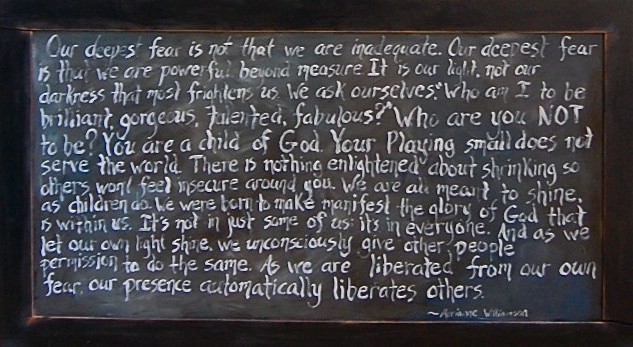
This is my favorite quote and creed to live by.